

Hey, I’m Marco 👋
I build in public toward €1M, and you get to watch and steal everything I learn. You can read more about me and my project here.
Revenue to date: €220,069 / €1,000,000
Every night looks the same lately. Put Isabel to bed. Clean up. Open the laptop. Check the metrics. Read the feedback. Plan tomorrow.
Tonight I’m doing something different: actually stopping to write down what happened this month.
I spent January listening.
Anapana had thousands of active users telling us what worked and what didn’t through app reviews, support messages, and behavior patterns we couldn’t ignore.
Coco had 30+ beta users sending detailed feedback: memory leaks, missing play states, courses that were too long before the exercises started.
Every message was either “this broke” or “I didn’t understand this.”
Both were equally useful.
That’s what this month was about: people helping me build something worth using.
What’s on My Desk
Coco Ear Training
Coco is finally ready.
Well, almost.
I spent January fixing everything that feedback revealed:
Bugs: Memory leaks, crashes, performance issues that only showed up when real people used it in ways I hadn’t imagined.
UX improvements: Theory lessons are now shorter and tighter. People wanted to get to the exercises faster, so I restructured the entire learning flow.
Audio engine rewrite: This was the big one. I had over 400 audio files per instrument (one file for every note, chord, interval). It worked, but it was bloated and slow. Now I have 32 files per instrument and generate everything on the fly by playing multiple notes together. A chord is just three notes played at once. Obvious in theory. Not so obvious to code, even with AI helping.
New features: You can now change instrument sounds and practice with scales exercises.
Right now, Coco has two complete courses:
Relative Pitch: Learn to recognize notes by comparing them to a reference.
Perfect Pitch: Train your ear to name notes without any reference.
What’s left before launch? Four more courses:
Melodic Intervals
Harmonic Intervals
Chords
Scales
Once those are in, I’m going public. Target: next week.
I’ll also publish a full “How I Build” deep dive on the entire process… from research to launch. If you want to read it, subscribe.
Anapana
Product
January was about fixing some frictions. We were tracking user behavior and discovered a problem: passwordless authentication was creating drop-off.
The flow seemed simple to us: enter your email, get a code, paste it, you’re in.
But users were getting stuck. Some never received the code. Others didn’t understand what to do next. A few just gave up.
So we added Google and Apple sign-in. One tap, you’re in. No codes, no waiting.
Registration is now faster, simpler, and way less frustrating.
We also shipped:
Fixed track playback and completion tracking (community-reported issues that were breaking sessions)
Redesigned the practice UX to feel more fluid and natural
Added filters and search (lots of users asked for this, turns out scrolling through 200+ meditations isn’t fun)
Behind the scenes, we started building personalized paths… custom meditation journeys based on your goals and progress. Not released yet, but coming soon.
Instead of throwing 200+ meditations at you and hoping you figure it out, we’re going to guide you.
Here’s how it works: during onboarding, we’ll ask you 10 questions to understand your goals, experience level, and what you’re struggling with. Then we’ll generate a custom path just for you… specific practices, in a specific order, designed to help you build a real habit.
No more choice paralysis. Just clarity.
Growth
We spent January building organic and paid acquisition channels from scratch.
The big focus was ASO (App Store Optimization). Last Friday we released a major update:
Changed the app name from “Anapana Studio” to “Anapana Mindfulness Studio”
Updated the subtitle to “Meditazione in italiano”
Rewrote the description
Created new screenshots
The results were immediate:
Keyword: Mindfulness. Before: Position 141. After: Position 66.
Keyword: Meditazione. Before: Not ranked. After: Position 161.
Keyword: Respirazione. Before: Not ranked. After: Position 124.

It usually takes 2-3 weeks to see the real impact, so we’re still monitoring. But early signs are promising.
I’ll write a dedicated post soon about everything I learned this month on ASO.
We also launched the Anapana Mindfulness Journal, a Substack blog to support SEO and content-driven growth.
And we’re starting to experiment with performance marketing on Meta to test paid acquisition alongside organic channels.
February is when we shift from foundations to growth.
Babytales
Still on hold while we sort out the printing provider situation.
Substack
One Million Goal reached 514 subscribers (+39 since December).
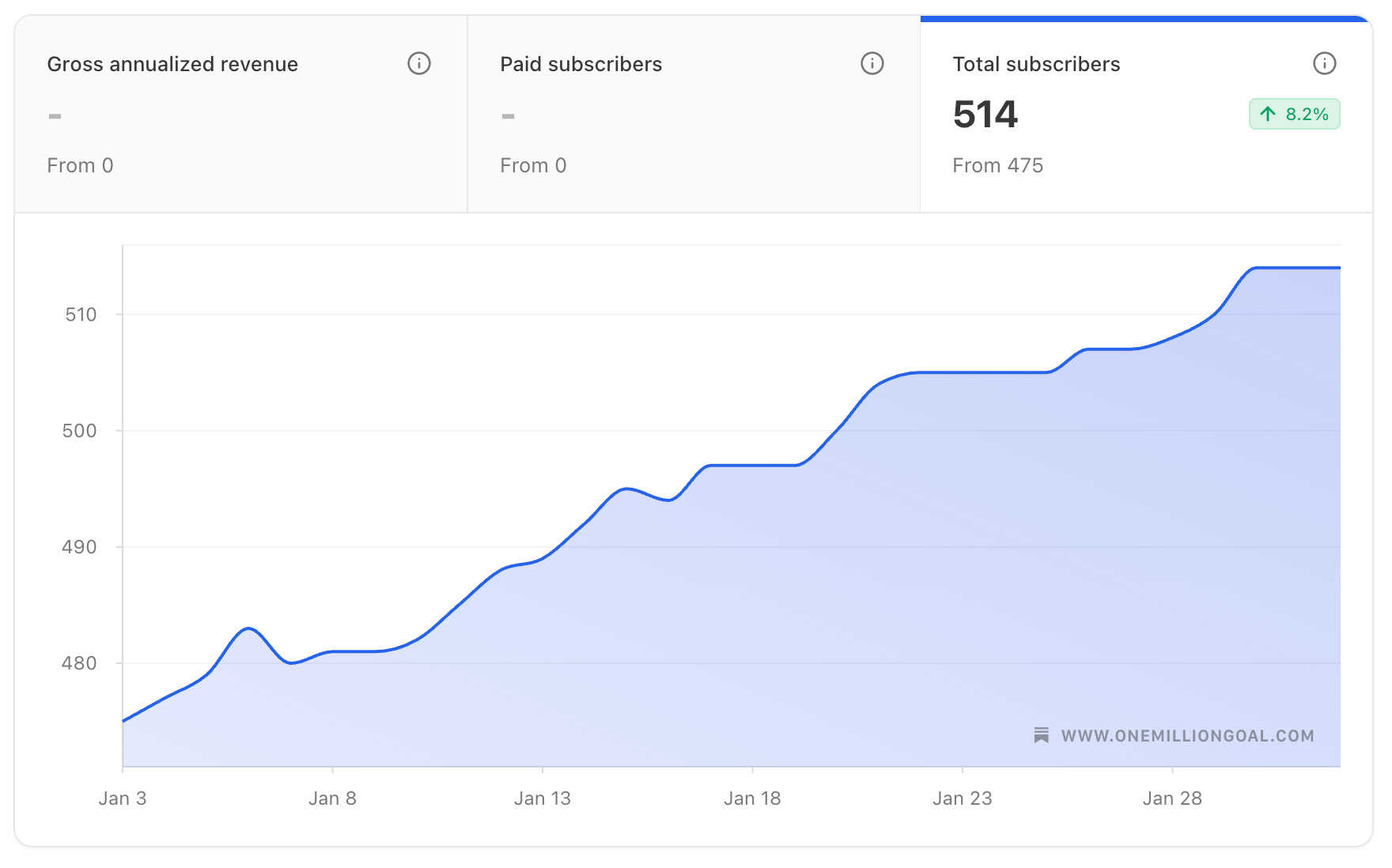
This month I posted less frequently and the growth reflected it. The numbers don’t lie: consistency drives growth.
So February is going to be an experiment:
2 posts per week
5 notes per day
I want to see if volume and frequency actually move the needle or if it’s all noise.
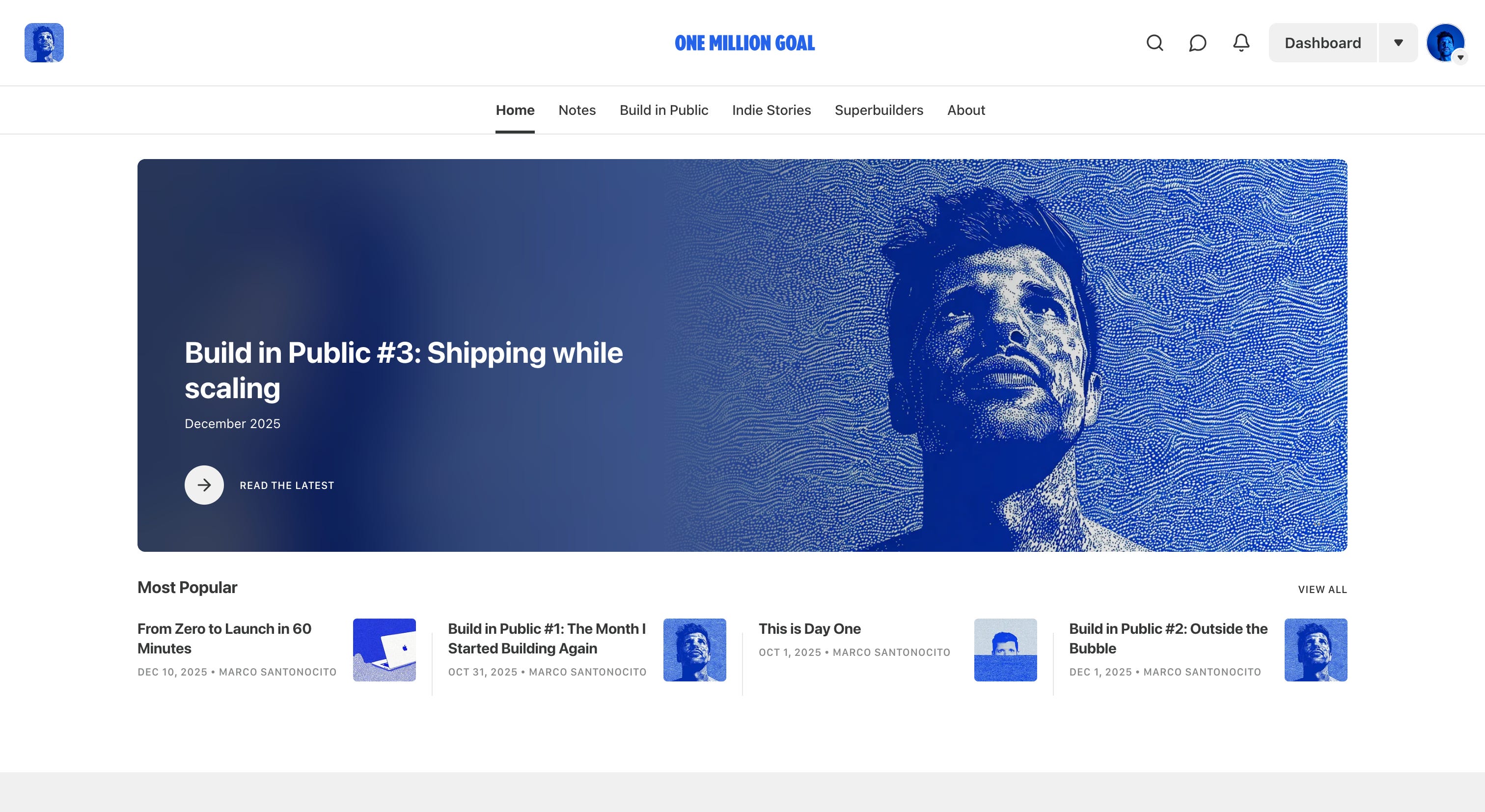
I also completely restyled the blog this month. New logo, new style, new images. What do you think?
And I activated the paid subscription tier this month. Not because I have a paid content strategy yet, but because I’m curious if having that option changes how Substack positions the newsletter algorithmically.
Will it impact discoverability? Recommendations? I have no idea. But the only way to find out is to test it.
Metrics Snapshot
Anapana: Revenue metrics remain private (shared project), but we’re profitable with healthy margins and reached break-even months ago.
Babytales: €0
Coco: €0 (not launched yet)
HeyBloom: still in private mode
One Million Goal (Revenue to Date): €220,069.80
Reflections
Last week I had a call with a friend.
We talked about growth strategies, specifically the kind of creative, organic tactics that actually work without burning money on ads. Things like UGC farming and TikTok research loops.
I’ll share more on this soon. For now, I’m just absorbing and thinking about how to apply it to Anapana and Coco.
The theme of January, though, wasn’t strategy. It was community.
I’ve spent years building products inside companies where feedback came through layers: PMs, user research teams, support tickets filtered and summarized.
Building solo is different.
When someone sends you a message saying “this crashed” or “I don’t understand this part,” you feel it directly. There’s no buffer. No one to delegate it to.
It’s a gift. The people who take time to tell you what’s broken. They care. They want you to succeed. And that’s worth more than any feature roadmap.
What’s Next
Anapana. Shifting to growth mode in February after a month of foundational work.
Coco launch. Next week. Finally.
Events. Two speeches coming up:
February 10th – Trieste: “Sviluppiamo un’app in 60 minuti con l’AI” (building an app in 60 minutes with AI, live on stage). Here’s the link.
February 19th – Milan: “Quando costruire non è più il problema” (when building is no longer the problem: a talk about how AI changed product development in 2026). No link yet but drop a comment, I’ll answer it as soon as the link is available.
Substack. Experiment with 2 posts per week and 5 notes per day.
Thanks for reading One Million Goal.
If you are building something, here’s a little reminder:
Ask for feedback early. Ask for it often. And when people give it to you, actually use it.
The gap between “I built something” and “I built something people want to use” is just that: listening.
Have a good month!
Marco Santonocito
Really solid breakdown of the feedback loop. The audio engine rewrite is clever - going from 400 files to 32 and generating on the fly must've been tempting to skip in favor of just shipping faster. I've noticed most builders struggle with knowing when to refactor vs when to just patch and move. Sounds like beta testers gave you that signal, which is the hole point of building in public.
Keep it up 🚀💪