

Easter Sunday. My cousin Mattia, who’s studying Medicine in Trieste, is showing me something on his phone between one slice of colomba and the next.
“Look at this. It’s called Doctordle. It’s all over TikTok.”
I looked. It was a list of symptoms, and you had to guess the diagnosis. Simple. Clean. And honestly... not that impressive.
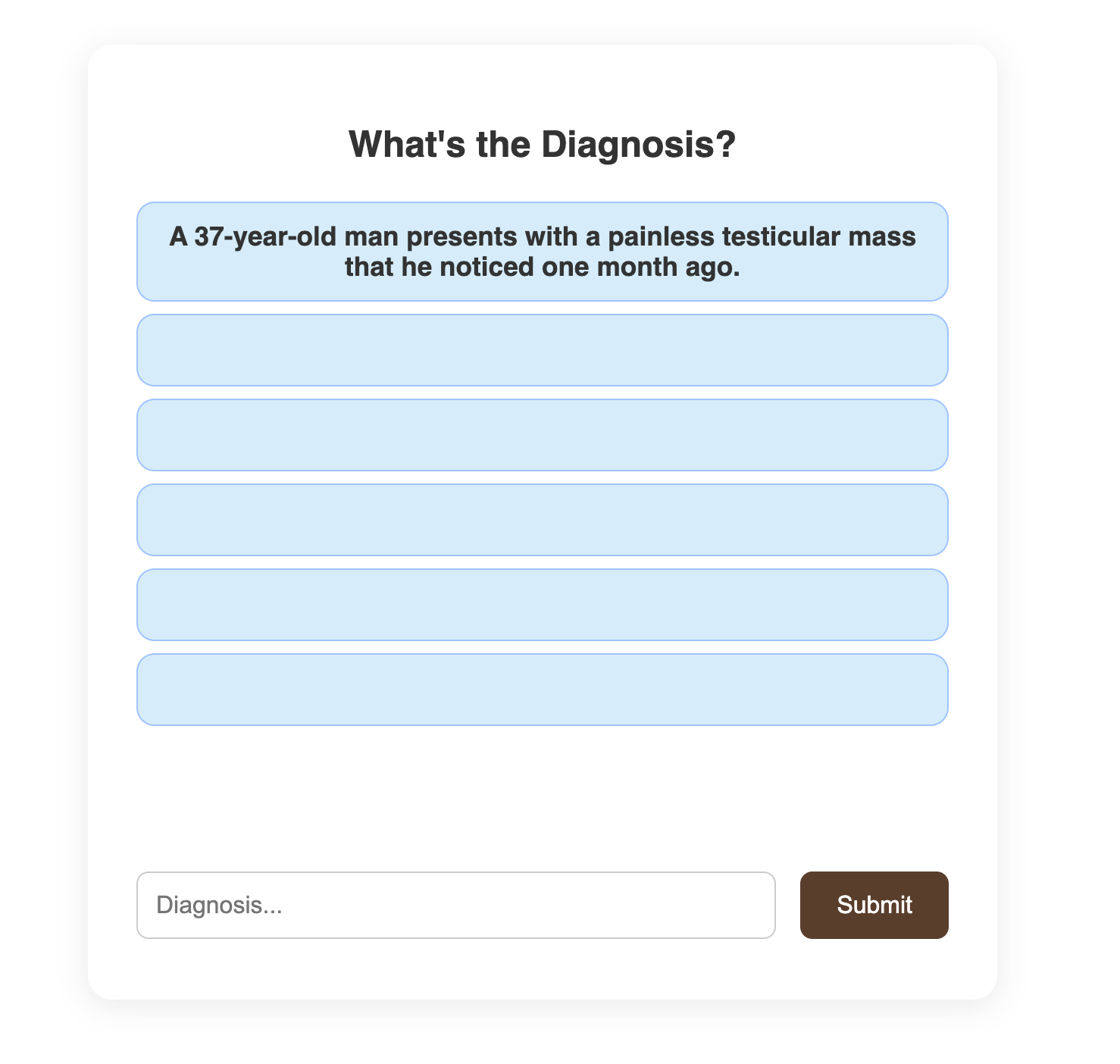
Because that’s not how medicine works.
A real doctor doesn’t get a neat list of clues. A real doctor sits in front of a person. Asks questions. Listens. Orders the right investigations. Connects the dots. Then, maybe, arrives at a diagnosis.
Doctordle was a guessing game. The real job to be done was clinical reasoning.
That gap stayed with me through the rest of lunch.
The night everything started
That evening, Annalisa and Isabel were asleep. The house was quiet. And I couldn’t stop thinking about what a better version of that game would look like.
Not a list of symptoms. A conversation with a patient. An AI-powered patient who talks like a real person, shares information gradually, and forces you to think like a doctor.
So I opened Claude and started writing a Product Requirements Document. Not a polished spec. More like a structured brain dump: what the core experience should feel like, what the MVP needs to prove, what can wait.
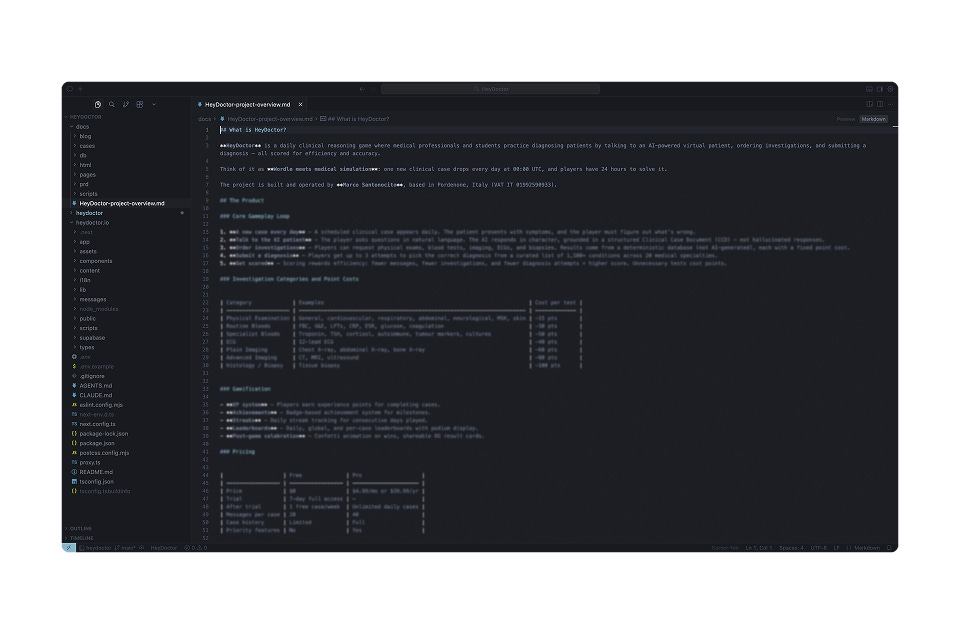
Then I passed the PRD to my agents in Cursor and let them work.
The next morning, I had a working prototype. Two hardcoded clinical cases. One chat interface. No leaderboard, no achievements, no fancy design. Just the core question: does talking to an AI patient feel real?
Mattia and Gabriel
I sent the link to Mattia. He shared it with his friend Gabriel, another med student in Trieste.
Within hours, they were hooked.
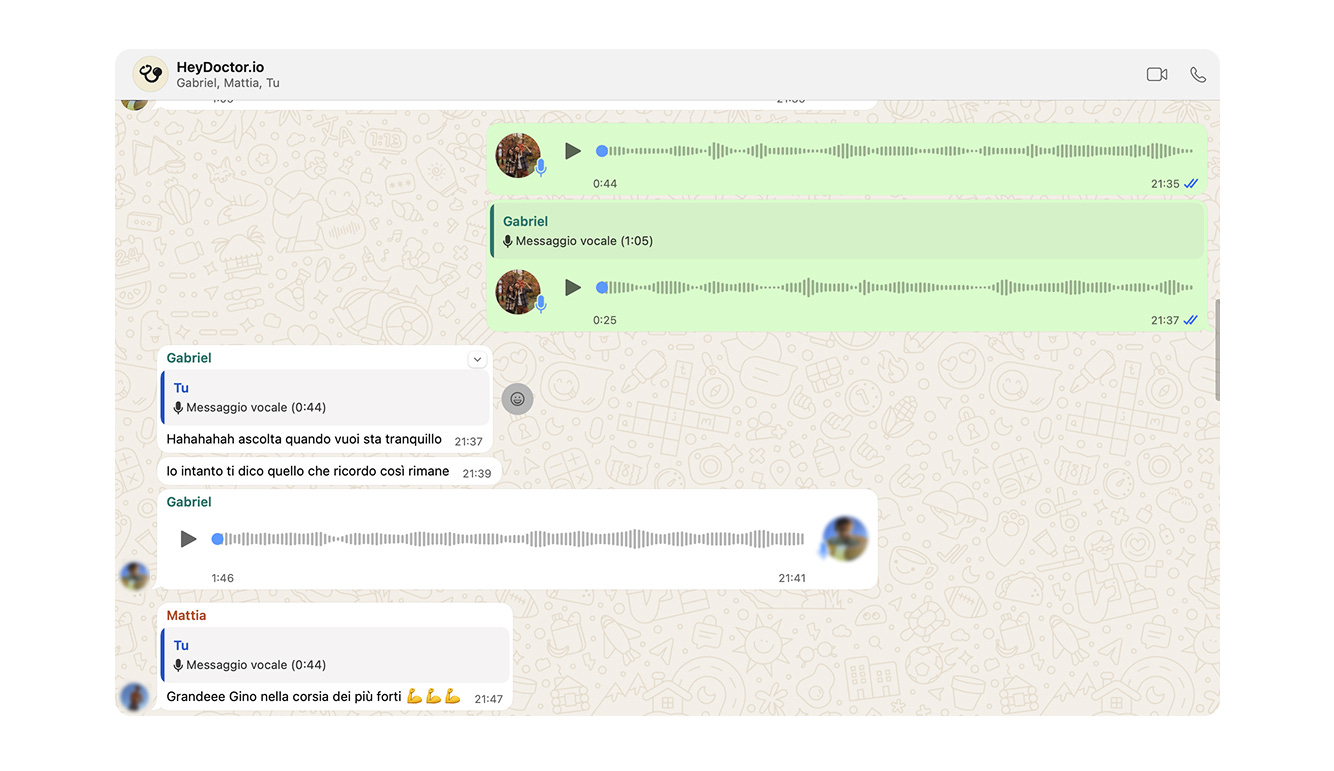
Not just using it. Competing. Comparing scores. Challenging each other to solve the case with fewer questions, fewer tests. The gamification layer I hadn’t built yet... they were already creating it themselves.
Their feedback was incredibly useful. The AI patient was convincing, the clinical scenarios felt real, and the overall experience was solid. But they also spotted something I hadn’t anticipated.
The patient was too helpful.
In some conversations, the AI would share information so completely that the diagnosis became obvious after two or three questions. In real clinical practice, patients don’t hand you a textbook presentation. They’re vague, confused, they forget details, they emphasize the wrong things.
So I tuned the prompts. Made the AI patient more human. Less forthcoming. The kind of patient who says “I’ve been feeling tired” instead of giving you a perfect description of their iron deficiency anemia.
That made the game dramatically better.
What HeyDoctor is
HeyDoctor is a daily clinical reasoning game. Every day at midnight UTC, a new case drops. You have 24 hours to solve it.
The experience follows the same logic a doctor would use in real life.
You start by talking to the patient. Ask questions in natural language. The AI responds in character, sharing symptoms, history, and concerns the way a real person would... gradually, sometimes imprecisely, always grounded in a pre-authored clinical case that ensures medical accuracy.
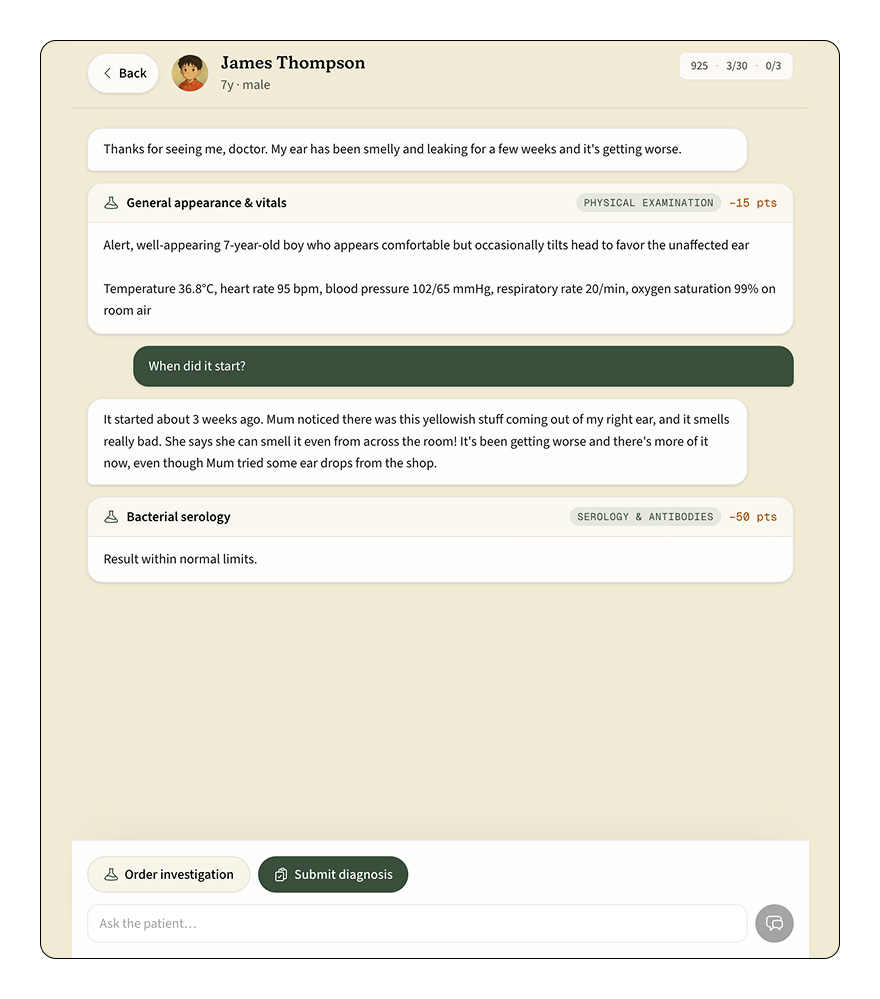
When you think you have enough from the conversation, you can order investigations. Physical exams. Blood tests. ECGs. Imaging. Biopsies. Each investigation has a point cost, because in the real world, ordering every test under the sun isn’t good medicine. It’s lazy medicine.
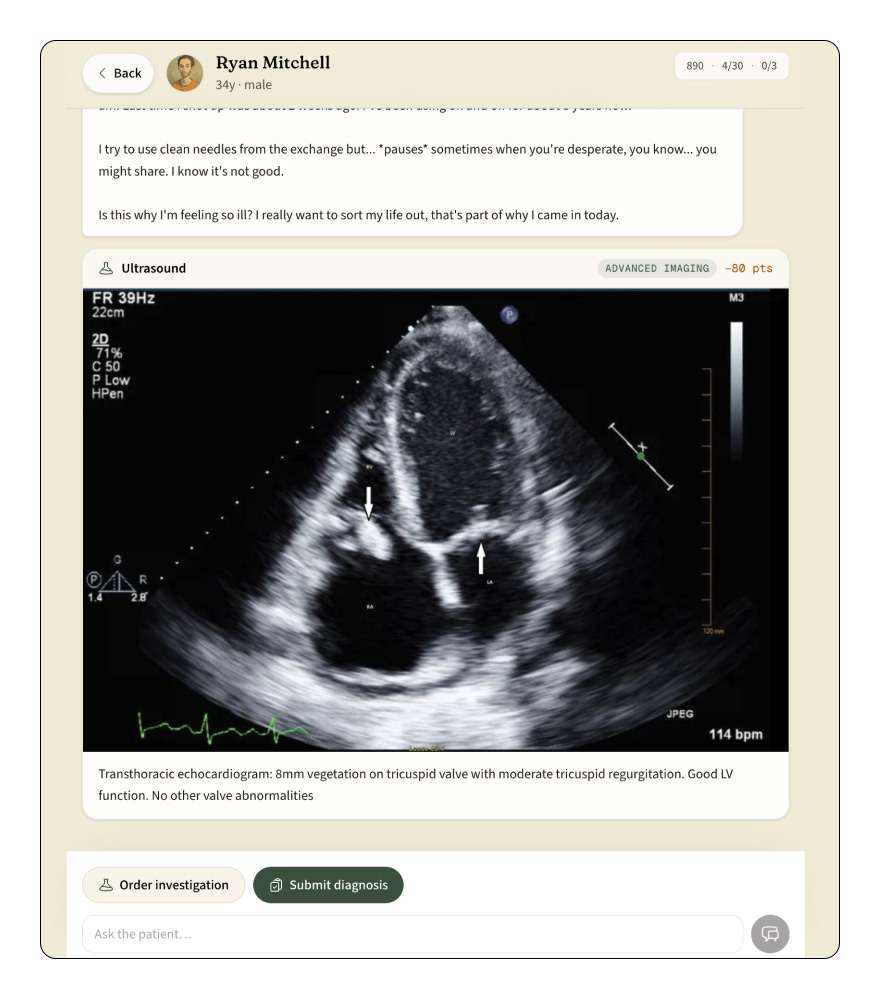
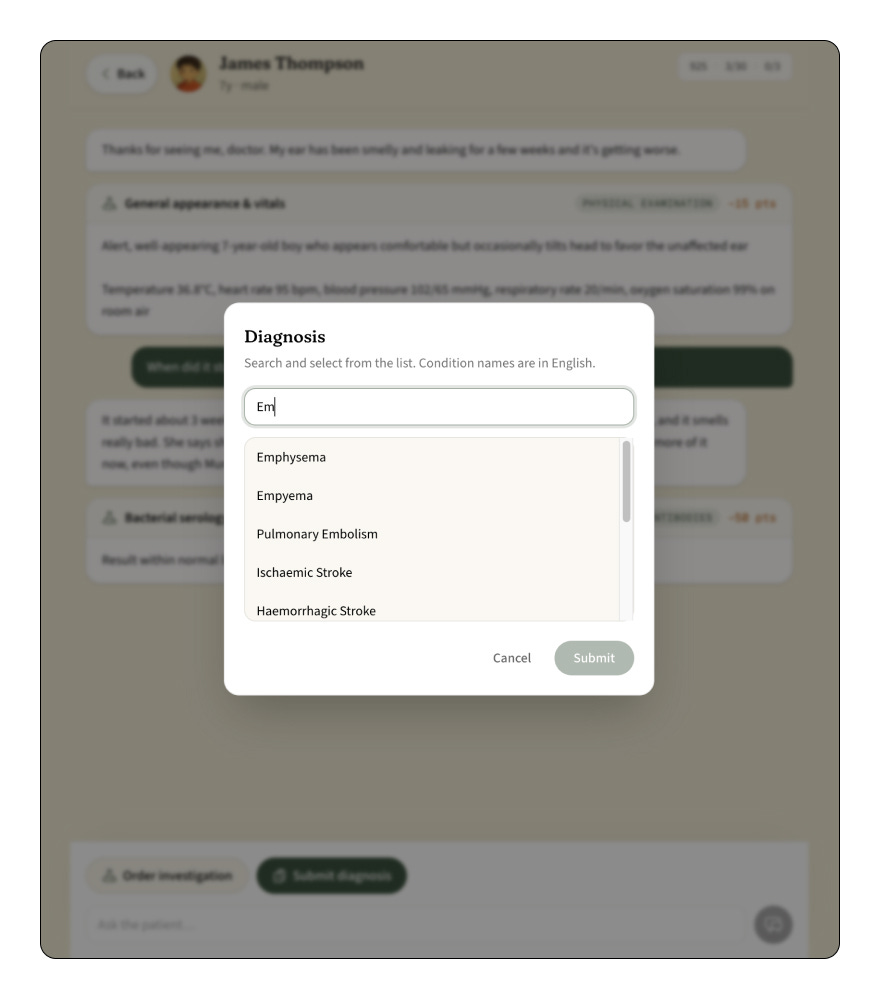
Then you submit your diagnosis. You get three attempts to pick the correct one from a curated database of over 1,100 conditions across 20 medical specialties.
Your score rewards efficiency: fewer messages, fewer investigations, fewer diagnosis attempts. The best doctors aren’t the ones who order everything. They’re the ones who ask the right questions.
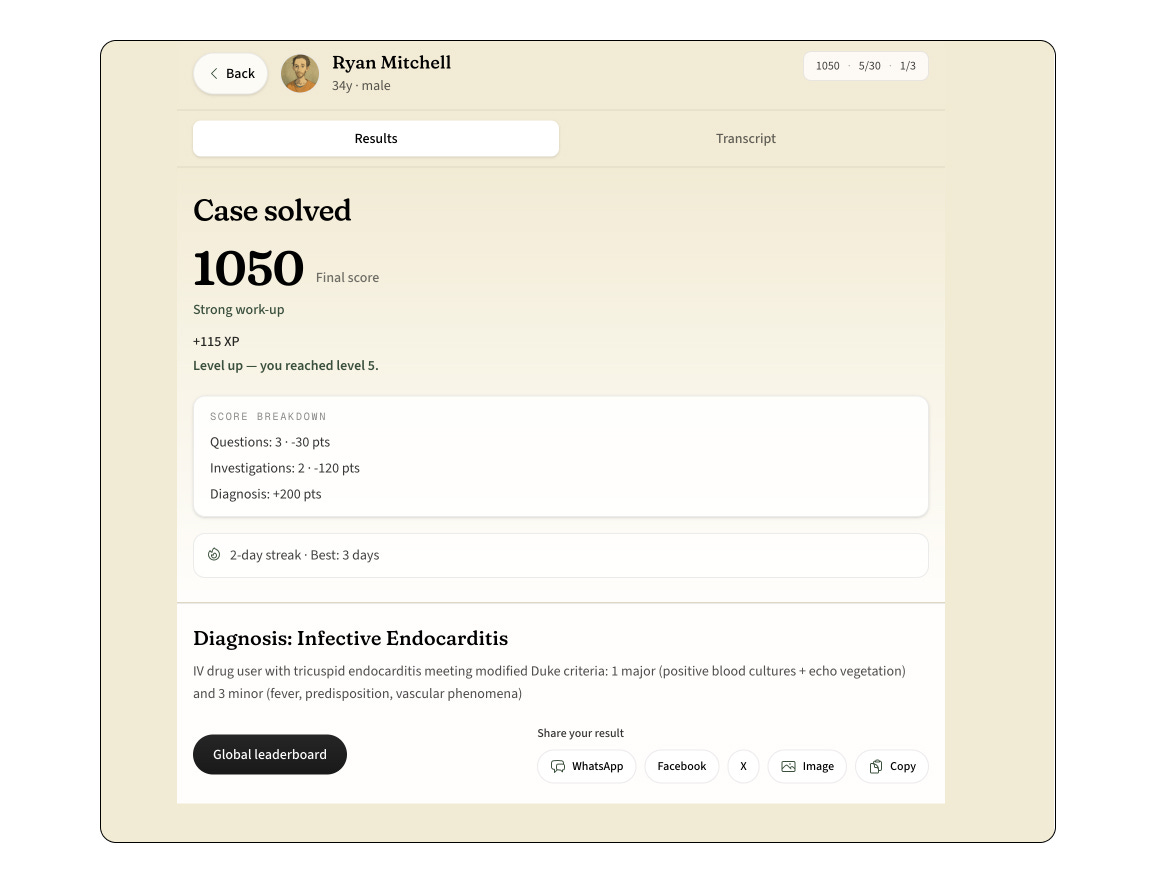
There’s a leaderboard, daily streaks, XP, and achievements. But the real hook is simpler than all of that. It’s the same thing that made Mattia and Gabriel compete: the satisfaction of cracking a case with minimal resources.
How a case is built
This is the part that surprised me most during development. The game feels spontaneous when you play it. The AI patient responds naturally, reacts to your questions, even gets a bit evasive sometimes. But underneath, nothing is improvised.
Every case starts with a real diagnosis. Community-acquired pneumonia. Graves’ disease. Something you’d find in a textbook or encounter on a ward round.
From there, I use AI (acting as a senior clinician, not a chatbot) to generate a complete clinical case dossier. This document contains everything: who the patient is, their background, how they’d describe their problem in everyday words, their medical history, lifestyle, family context, what you’d find on physical exam, and pre-written results for every single investigation the game allows.
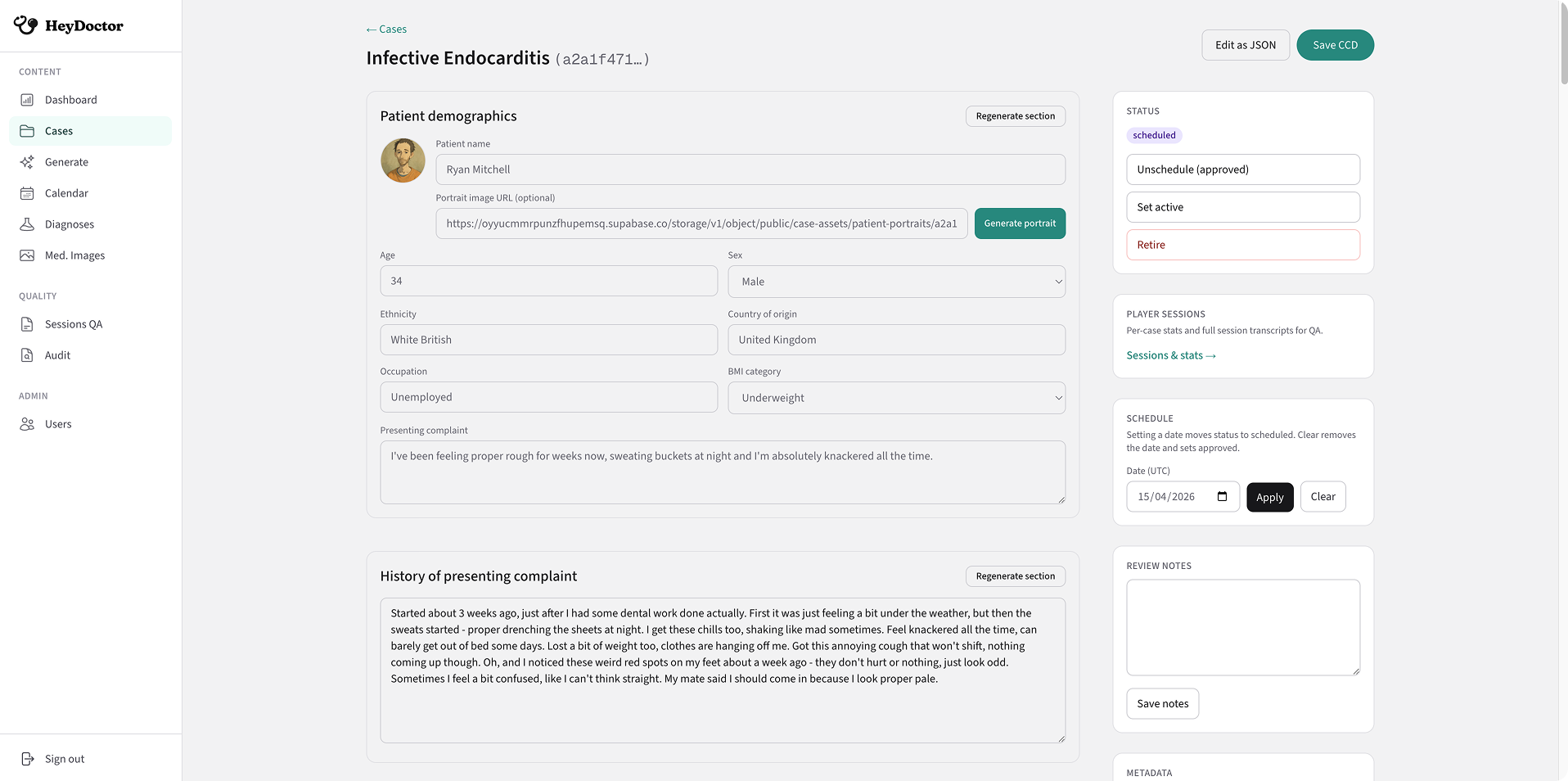
That last part is critical. When you order a blood test in HeyDoctor, the app doesn’t ask the AI to invent a result on the fly. It looks up the answer that was already written and validated. This keeps investigations consistent and prevents the case from contradicting itself mid-session.
The AI patient’s first words get translated into four languages (English, Italian, French, Spanish) with the same clinical intent but natural, localized wording. And every generated case goes through a quality checklist: required sections present, patient language believable, diagnosis not accidentally revealed in the opening story.
Then it’s saved as a draft. Publishing is always a separate, deliberate step. The “one new case at midnight” rhythm stays curated and intentional.
I built a full admin panel to manage the whole pipeline: case generation, diagnosis management, scheduling, session review. For building the library faster, there’s also a batch tool that can generate many cases at once from a checklist of diagnoses.
One sentence to summarize the philosophy: cases are written like structured teaching scripts, with every investigation answer decided in advance, so the daily puzzle is fair, consistent, and medically grounded... while the AI patient still feels alive when you talk to them.
The numbers behind the price
Before setting a price, I tracked AI costs across dozens of test sessions. One conversation with the AI patient costs between €0.002 and €0.05, depending on length and complexity.
That data gave me confidence. At €9.99/month, the margins are healthy enough to reinvest in product development and marketing. Free users get one case per week. Pro unlocks every daily case, and full case history.
I didn’t guess the price. I calculated it from actual usage data. That’s one of the advantages of building with AI: you can measure the cost of every interaction before you commit to a business model.
Two weeks
From Easter lunch to a live product with 1,100+ diagnoses, four languages, leaderboards, achievements, streaks, an admin panel, and a case generation pipeline.
Two weeks.
I’m not saying this to brag. I’m saying it because two years ago, this would have taken months. Maybe longer. The tools have changed. Cursor, Claude, the whole agentic workflow... they compress the build phase in ways that still surprise me.
But the insight didn’t come from AI. It came from watching Mattia swipe through Doctordle and thinking: this isn’t how doctors actually work.
The build was fast. The observation was the real starting point.
Try it
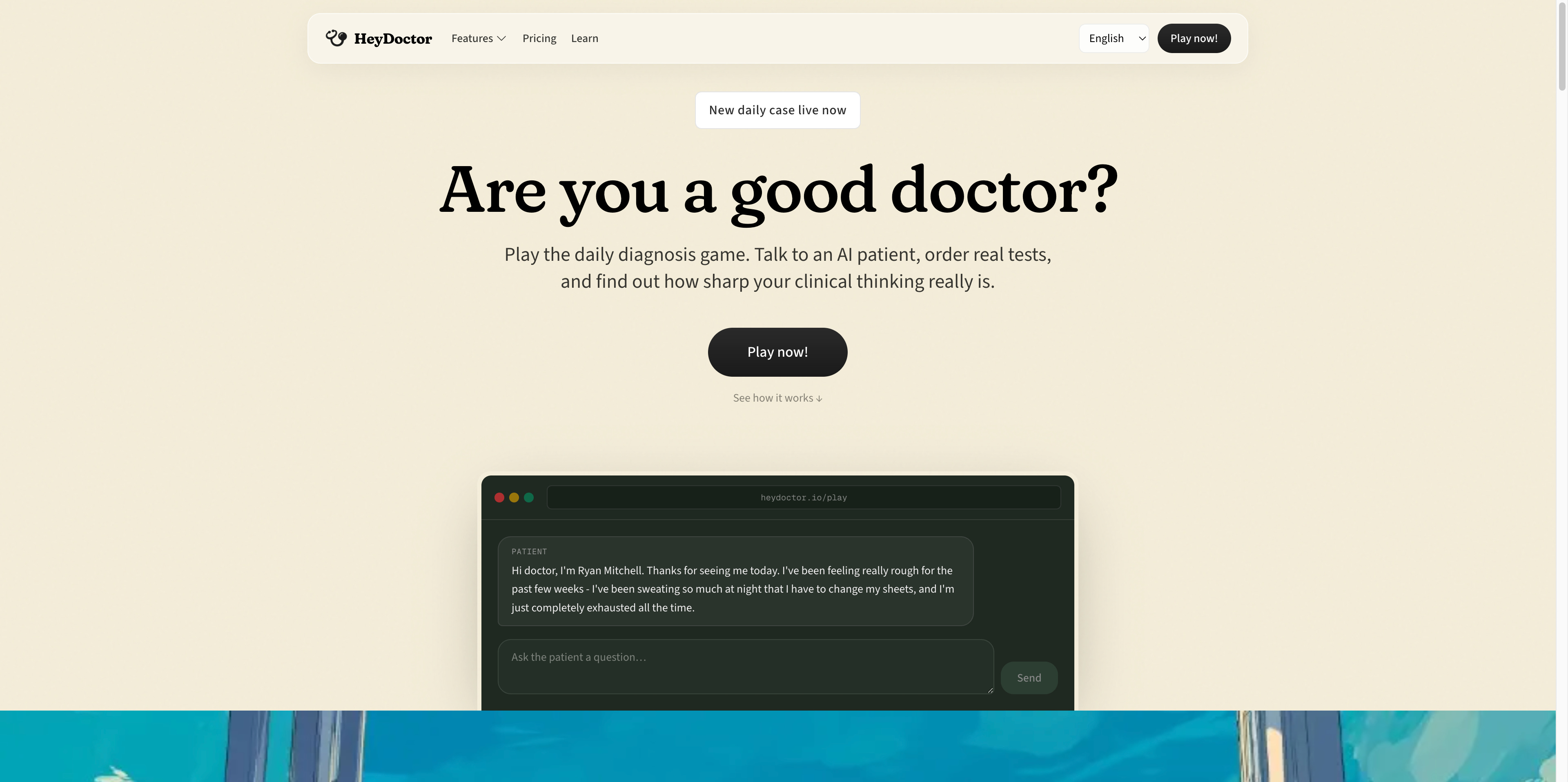
If you’re a medical student, a junior doctor, a nurse, or just someone curious about clinical reasoning, I’d love for you to try HeyDoctor.
One new case, every single day: heydoctor.io
And if you play it... tell me what you think. Every piece of feedback from Mattia and Gabriel made this product better. Yours will too.