

Hey, I’m Marco 👋
I build in public toward €1M, and you get to watch and steal everything I learn. You can read more about me and my project here.
Revenue to date: €220,069 / €1,000,000
Early supporters get everything: templates, step-by-step guides, and exclusive content. First year is totally free.
For years, I had the same problem every builder has.
Too many ideas and not enough clarity about which ones to build.
I’d get excited about something, start working on it… Then, three weeks later, I’d wonder if I’d picked the wrong thing.
Or worse: I’d forget ideas completely.
At some point I realized I didn’t need more ideas.
I needed two things:
A way to capture every idea, without losing it
A way to decide which one actually deserved my time
So I built a system.
From a Moleskine to Notion
I carry a Moleskine everywhere. When an idea hits, I write it down immediately.
The notebook is my thinking tool.
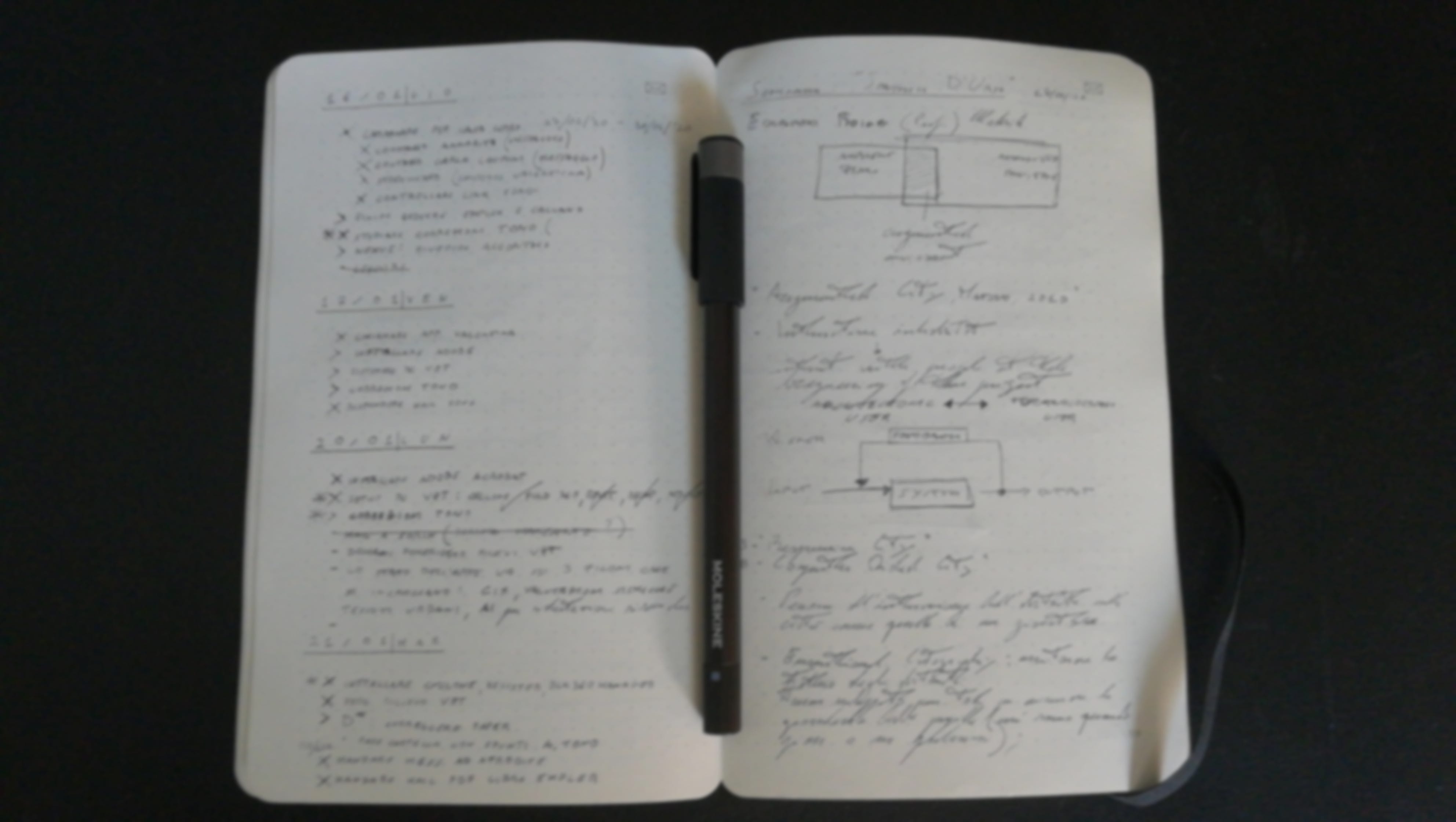
But every idea that survives the first spark eventually moves to Notion.
Notion is my working database. It’s where ideas become structured, queryable, comparable. It’s where I can access them from anywhere, filter by category, sort by priority, and actually make decisions.
The notebook captures.
Notion organizes.
The System
My system has three stages:
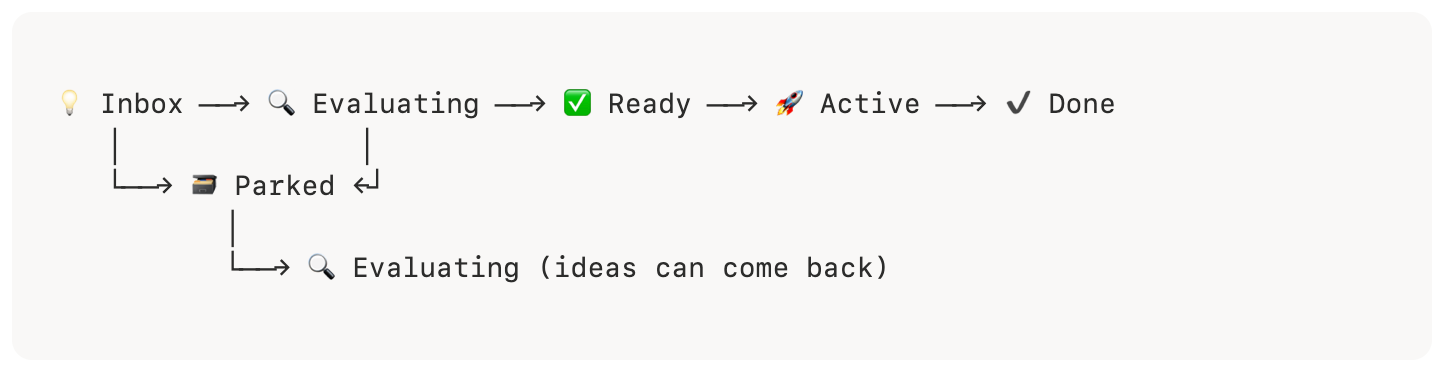
Capture → Evaluate → Commit
Stage 1: Capture
When an idea shows up, I add it to my Inbox.
Just two fields:
Name. What I’m calling it
Description. One sentence: what is this and for whom?
If I can’t describe an idea in one sentence, it’s not clear enough yet.
Stage 2: Evaluate
Once a week, I open the Inbox and start to answer reflection questions:
What’s the problem?
Who needs this?
What’s the biggest risk?
What could be the first move?
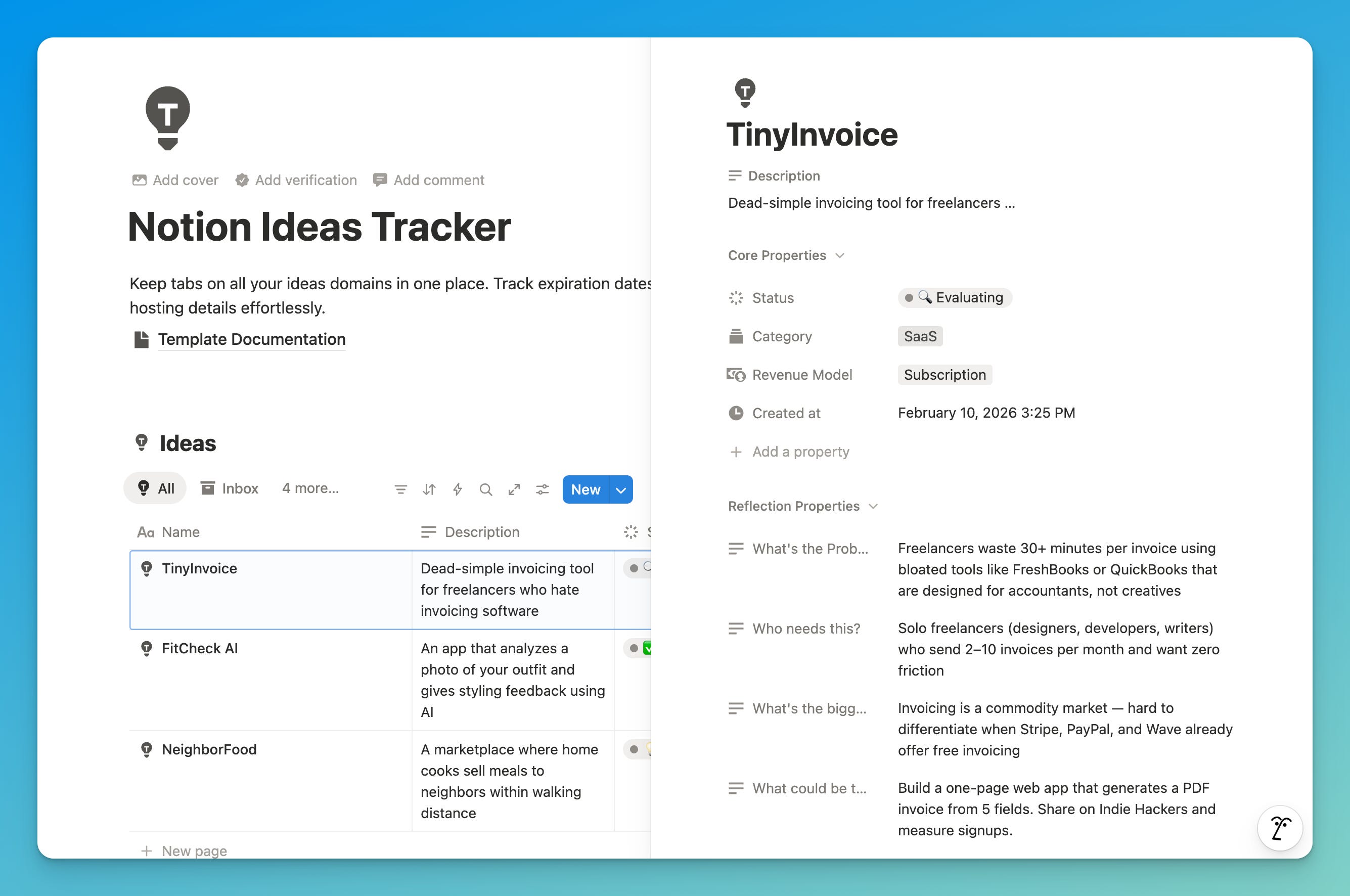
These four questions map to the four ways ideas fail:
No real problem
No real user
Unexamined risks
No clear starting point
If an idea survives all four, it earns the right to be scored.
If it doesn’t, I move it to Parked.
Stage 3: Commit
Only ideas with status Ready get scored.
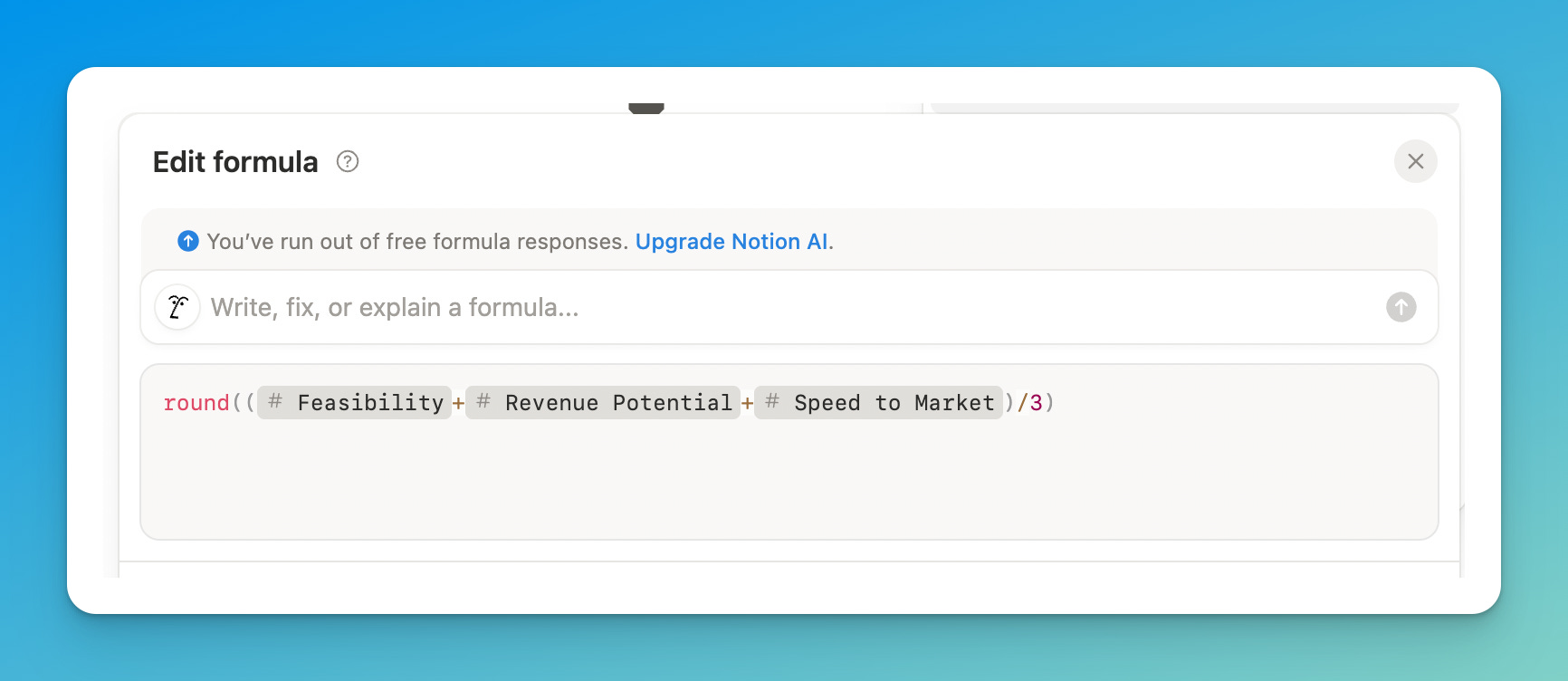
Three dimensions, each from 1 to 5:
Feasibility. Can I actually build this?
Revenue Potential. Will it make money?
Speed to Market. How fast can I ship v1?
Score = (Feasibility + Revenue Potential + Speed to Market) / 3Then there’s one final check:
Excitement (🔥 High / 👍 Medium / 😐 Low)
Excitement doesn’t go into the formula. It’s a tiebreaker.
If two ideas score 4.0, I pick the one that makes me want to open my laptop at night.
Coco: the system in action
Here’s a real example.
PitchPlay (now called Coco) is an ear training app for musicians.
I captured it in Inbox, then moved it to Evaluating and answered the four questions:
What’s the problem?
Musicians struggle with pitch recognition. Most apps are just random quizzes with no structure.Who needs this?
Adult musicians who want to develop better relative pitch.What’s the biggest risk?
Download, try once, never come back. Retention will make or break this.What could be the first move?
Research ear training methods. Talk to 5 musicians about their struggles.
The idea survived.
I scored it:
Feasibility: 4
Revenue Potential: 3
Speed to Market: 4
Excitement: 🔥 High
Total score: 3.7/5
It ranked #2 in my list.
Then I did what I always do after scoring.
I validated.
I talked to musicians. I checked Reddit threads. I researched keyword demand. I read papers on pitch training.
Everything pointed to the same conclusion: this was the right idea to build.
So I built it.
Today, Coco is in beta, tested by 30 users, and launching publicly soon.
The weekly rhythm
I don’t touch the database on a schedule.
I add ideas whenever they show up. Sometimes daily. Sometimes once a week.
But when I’m deciding what to build next, I open Notion, sort by score, and look at the top five.
Then I ask:
Do I have validation data for this?
Is the timing right?
Can I start this now without abandoning something else?
The system doesn’t think for me. It just gives me clarity.
Instead of drowning in possibilities, I’m looking at a shortlist of ideas that already passed the first filter: feasibility, revenue potential, speed, spread, alignment.
From there, the decision becomes easier.
What this system does for me
1. Nothing gets lost. Every idea has a home.
2. I don’t waste time scoring garbage. Only ideas that survive evaluation get scored. Cuts my scoring time by 80%.
3. I can move faster. When I finish a project, I have a Scoreboard of Ready ideas waiting.
Download
You can download the template here:
What’s your system for managing ideas? Reply and let me know.
Want to follow my journey from zero to one million? Subscribe to get real numbers, lessons learned, and the behind-the-scenes story of building in public.